Conservation of an Artwork on Paper
Claire Forrester, Paper Conservator
Claire Forrester, Paper Conservator
The Library’s collection of artworks on paper underwent conservation treatment over a number of years. The collection was surveyed, those works of art that needed attention were identified and, given the size of the collection, a treatment plan was created to cater for the number of artworks and general good condition of the art works. The approach taken in the treatment plan was that of minimal intervention. In other words, the conservator mainly tried to stabilise the work of art in its current condition through proactive treatment of harmful ancillary materials (acidic backing boards, sellotape, masking tape, acidic mounts, etc.) and the introduction of quality archival materials and storage.
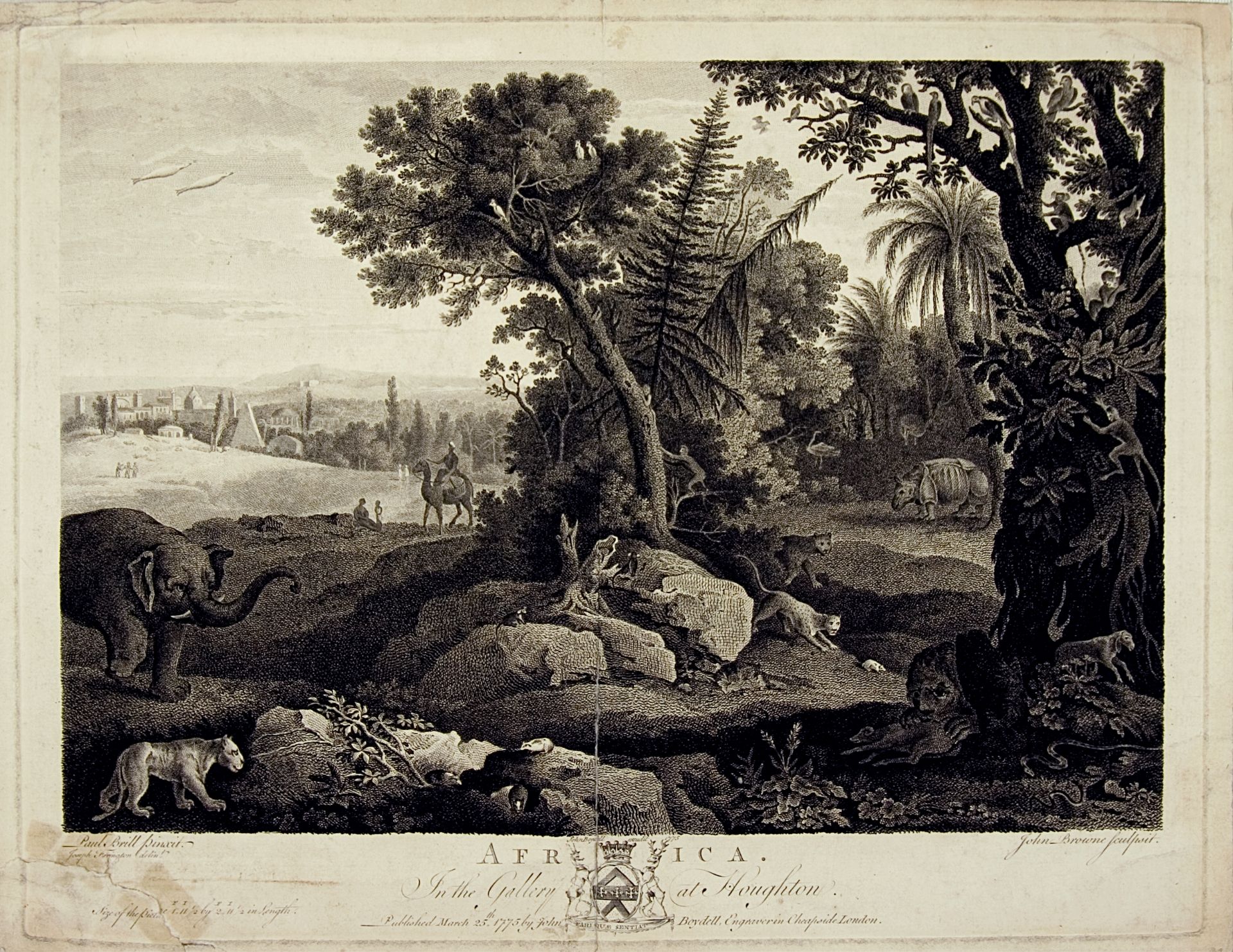
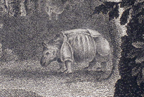
One of the art works which was treated was an interesting engraving Africa, after Paul Bril, published in 1775 by John Boydell as one of the Houghton Gallery prints. Bril (c.1554-1626) was born in Antwerp but worked in Rome, where he became well known for his imaginative landscapes. This engraving depicts a jungle scene with numerous animals, including an Indian elephant, an Asian rhinoceros and strange wingless birds in the sky.
The conservator was attracted by the almost human faces of the cats and the fact that in the background a North African city complete with pyramid and camel are shown so close to the jungles of central Africa. The engraving is on good quality handmade paper, which was commonly used at the time. Machine-made paper was invented in the early 1800s.
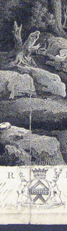
The condition of the artwork was reasonable. The main concerns were the tear down the centre of the paper, the bad repair in the left bottom corner, the sellotape and glassine paper repairs on the back, and the non-archival paper hinges on the back. The artwork also had moderate surface dirt which was giving the paper a grey appearance. The artwork had been stored archivally so there was no discolouration or embrittlement of the paper which meant that there was no need to undertake wet treatments (such as washing).
The first treatment carried out on the artwork was surface cleaning. A soft bristled brush was used to gently remove any loose surface dirt on the front and back. Grated eraser was then used around the edges of the image and on the back to remove more engrained dirt. As seen in the photograph the paper was relatively dirty.
Following surface cleaning a heated tool was used to separate the sellotape from the artwork. Unfortunately, the stains left by the sellotape could not be removed although a scalpel was used to scrape them down and reduce the intensity. A poultice was then used to remove the old glassine repairs and hinges. A poultice helps introduce moisture in a controlled way so as to soften the adhesive used in the repair. Once softened the repair/hinge is easily lifted off.
Once all the non-archival ancillary materials were removed the conservator set about repairing the tears and areas of loss with archival materials. Repairs were done with Japanese paper which is acid free and very strong yet thin. The adhesive used was wheat starch paste which is considered archival and used by conservators around the world. Once the repairs were done the artwork was humidified and pressed between silicon release and blotting paper.
The conserved artwork was then placed in a protective melinex film envelope for storage.